January 14, 2026
I vibe-coded a slow app: fixing Vercel + Neon latency the hard way
My first project of 2026, kidou.dev, was supposed to be a quick win. Modern stack (Vercel + Neon), AI-assisted code, clean architecture. I’d vibe-coded the whole thing in a weekend.
But once deployed, it felt sluggish. We’re talking 500ms to 800ms per request.
I spent hours debugging. Mass-optimized queries, added indexes, refactored logic. Barely any change.
Here’s the thing about vibe coding in 2026: Cursor and Claude will write you valid code. Efficient SQL. But they won’t tell you that your database is in Singapore while your server is in Washington. They assume a spherical cow in a vacuum.
The problem wasn’t my code. It was physics.
If you’re building with serverless (Vercel, Next.js, Neon/Supabase) and your app feels slow, stop optimizing your loops. Read this first.
The symptom: invisible latency
You deploy your app. The database is on Neon (serverless Postgres). The frontend is on Vercel. But every request crawls. Cold starts feel eternal.
Your first instinct is to check your SQL queries. Wrong instinct.
I measured it: my queries were taking 15ms to execute on the DB, but the request was taking 800ms to return. Where did the other 785ms go?
They were lost in two invisible killers: Geography and Handshakes.
Invisible killer #1: the world tour
Nobody tells you this when you start with Vercel: the default region for Serverless Functions is Washington D.C. (iad1).
I’m based in Thailand. My Neon database was in Singapore (sin1)—makes sense for my location, right?
But because I didn’t explicitly configure Vercel, here’s what happened for every single request:
- Me (Thailand) → Request → Vercel Function (Washington D.C.)
- Vercel Function → Query → Neon DB (Singapore)
- Neon DB → Data → Vercel Function (Washington D.C.)
- Vercel Function → Response → Me (Thailand)
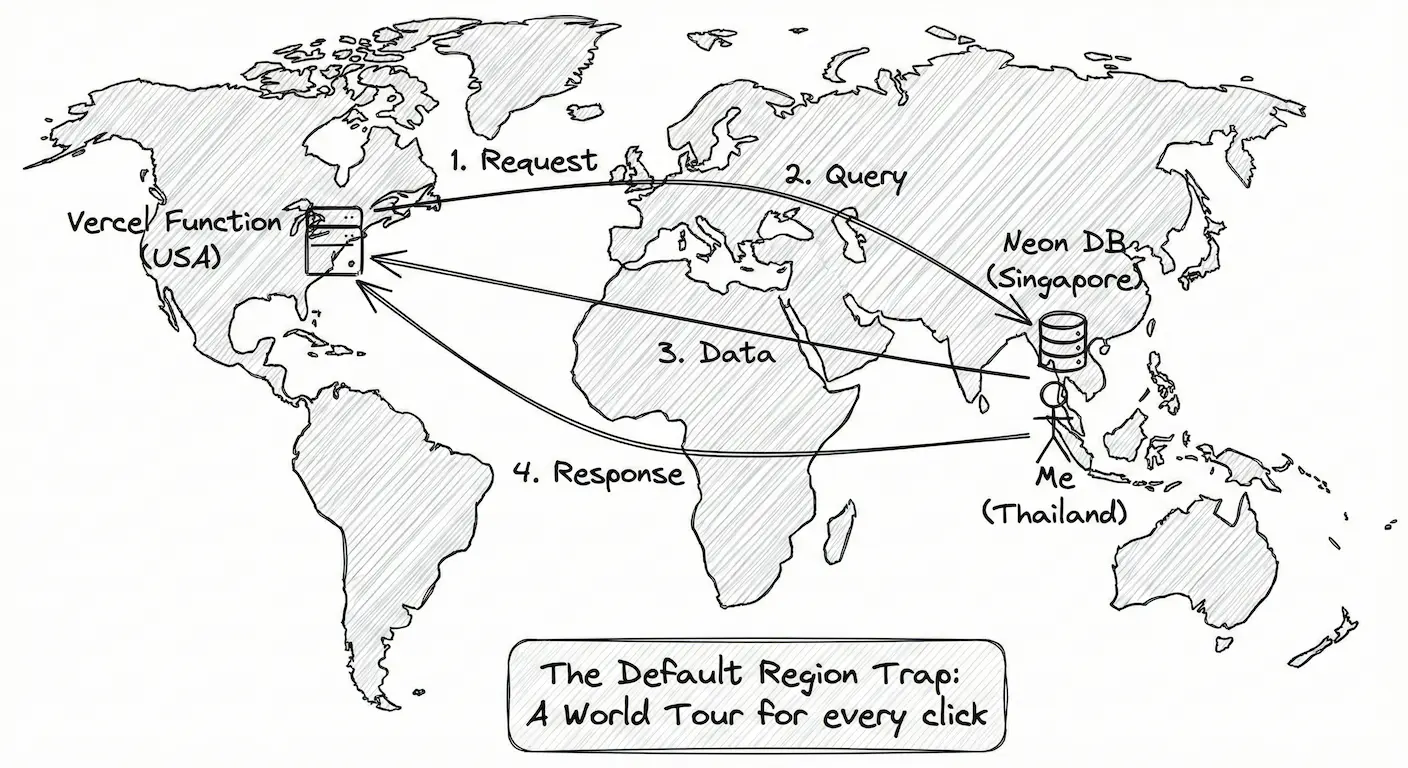
That’s a double intercontinental roundtrip. Just the speed of light through fiber optics accounts for 300-400ms of latency. Not slow code. Just distance.
The fix: colocate your compute
Move your backend logic right next to your database. One file.
Create a vercel.json at the root of your project:
{
  "regions": ["sin1"]
}
Now your function runs in Singapore. The distance between your code and your database is near-zero.
Result: ~500ms network latency → ~20ms.
Invisible killer #2: the TCP tax
In a traditional server setup (VPS), your app connects to Postgres once, keeps the connection open, and reuses it.
In serverless, functions are ephemeral. They spin up, run, and die. For every cold start, your app negotiates a fresh connection to the database.
Standard Postgres drivers use TCP. A full TCP connection involves heavy handshakes (TCP + TLS + Postgres auth). It adds a consistent 100-300ms tax before your SQL is even sent.
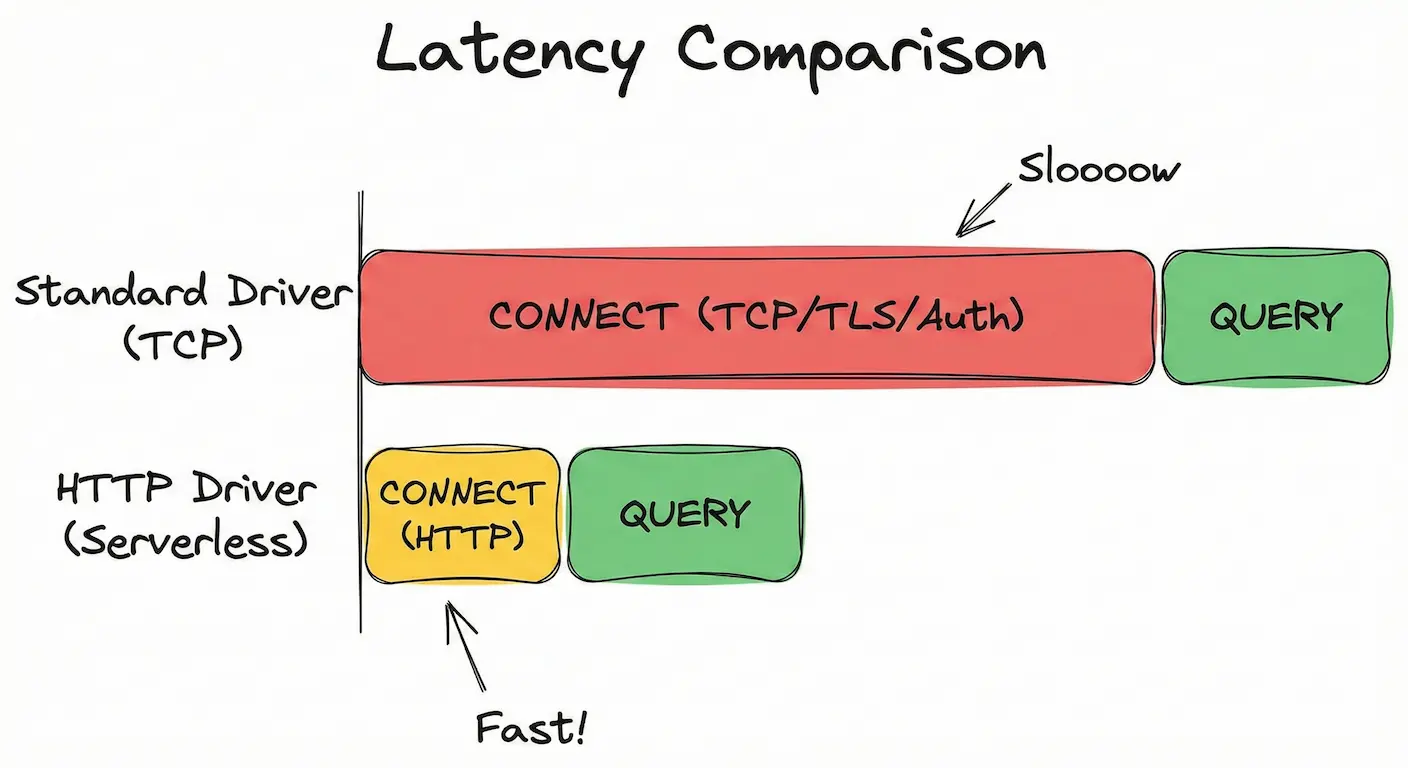
The fix: switch to HTTP
Neon provides a specialized driver (@neondatabase/serverless) that communicates via HTTP/WebSockets. It uses a proxy that maintains warm connections to Postgres. Your function just does a quick HTTP handshake—significantly faster for one-shot executions.
Before (standard driver):
import postgres from 'postgres';
const client = postgres(DATABASE_URL); // Heavy TCP start
After (serverless-optimized):
import { neon } from '@neondatabase/serverless';
const sql = neon(DATABASE_URL); // Lightweight HTTP
This simple switch shaved off another 150ms from cold starts.
The result
Two infrastructure changes. Zero application logic touched.
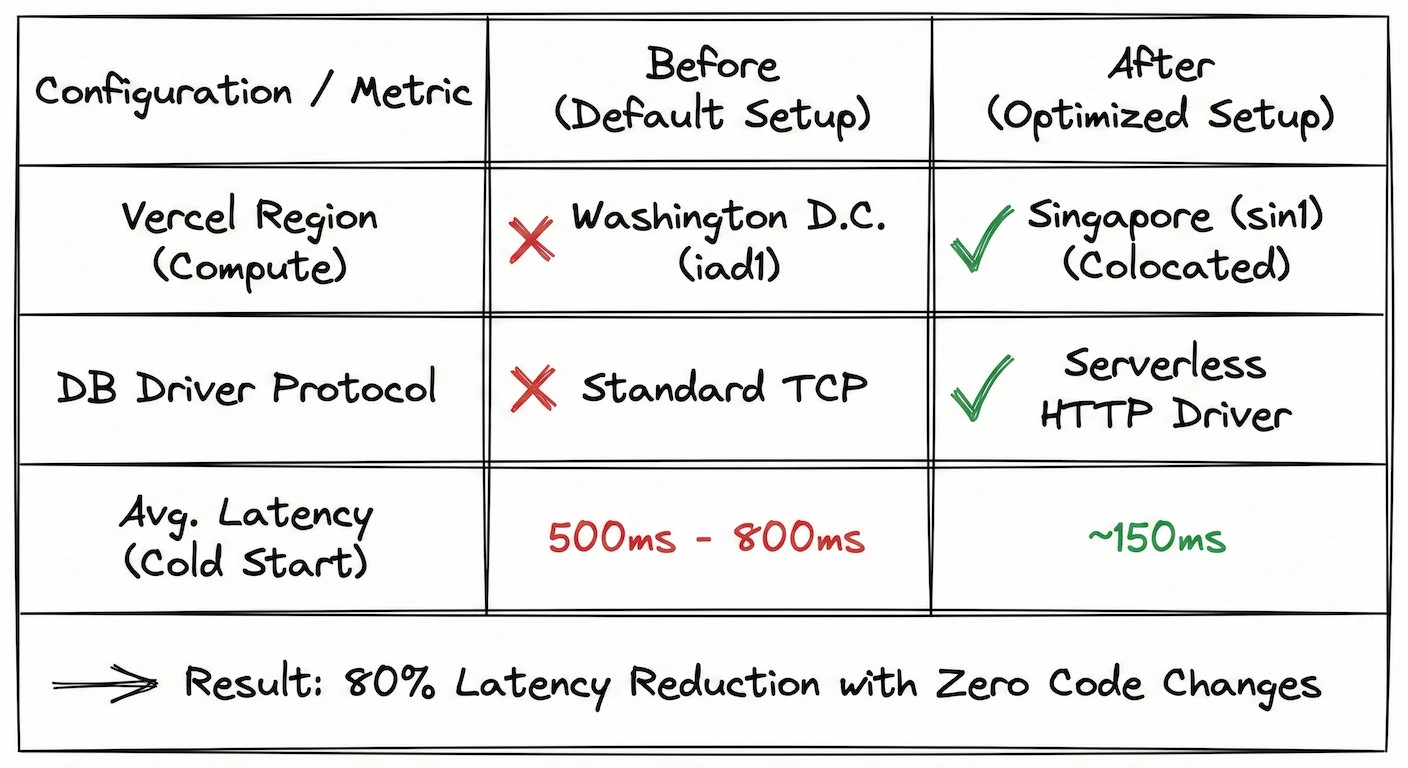
- Fixed geography:
vercel.json(iad1 → sin1) - Fixed protocol: TCP → HTTP driver
The app became snappy instantly.
The meta lesson for vibe coders
This is the uncomfortable truth about AI-assisted development in 2026.
I used Claude to write this app. The AI wrote valid code. Efficient SQL. Clean architecture. But it had no idea about the physical topology of my infrastructure. It couldn’t see that I was sending data on a world tour for every click.
Vibe coding is fast. It’s genuinely powerful. But it abstracts away the physics of the internet.
You can generate the code. You still have to own the architecture.
The serverless speed checklist
Before you rewrite your code, check the physics:
- Where is your DB? (Physical region)
- Where is your function? (Check Vercel defaults—it’s usually US East)
- Are they neighbors? (Colocation is king)
- Are you using a serverless-ready driver? (HTTP > TCP for ephemeral functions)
Peace. ✌️